
Business email compromise is a scam where someone impersonates a person you trust by email, an executive, a vendor, a lawyer, to get your business to wire money or hand over sensitive information. It doesn’t need malware, just a convincing message and someone busy enough to act on it before double-checking. In 2025 alone, the FBI’s Internet Crime Complaint Center logged $3.05 billion in reported BEC losses across nearly 25,000 complaints, up 10% from the year before.
This post walks through how BEC actually works, the warning signs worth teaching your team, and the specific steps that stop it before it costs you anything.
What Is Business Email Compromise (BEC)?
BEC is targeted impersonation, not a mass phishing blast. A scammer picks a real person you’d trust, your CEO, a regular vendor, outside counsel, and sends a message that looks like it came from them. Sometimes the sending domain is spoofed with one swapped letter, and sometimes the scammer has actually broken into that person’s real inbox and is waiting for the right moment to act.
That’s what separates BEC from ordinary phishing. A phishing email usually carries a malicious link or attachment and gets blasted to thousands of inboxes hoping a few people click. No malware, no link to flag, just a request that sounds exactly like something you’d normally act on.
And these threats don’t discriminate by business size. A 12-person accounting firm is just as viable a target as a Fortune 500 company, sometimes more so.
How Do Business Email Compromise Attacks Work?
Most BEC attacks follow a pattern once you’ve seen it enough times. The scammer starts with research: a company website, LinkedIn, a press release announcing a new CFO, all of it tells them exactly who to impersonate and who to target. Contact comes next, usually by email, sometimes from a spoofed domain that looks right at a glance.
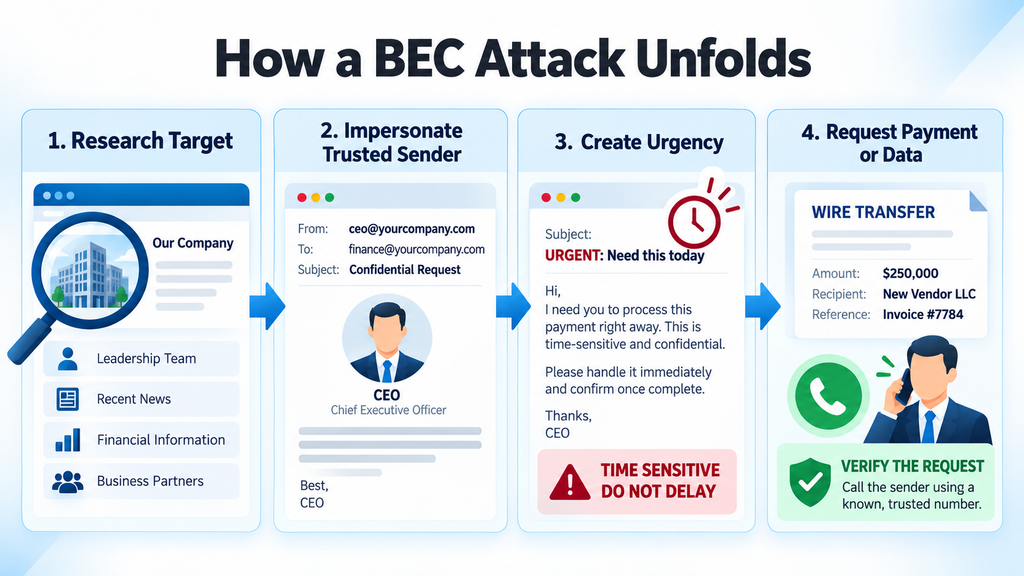
The ask follows fast, wrapped in urgency: a wire transfer needed before a deadline, a vendor’s bank account that supposedly changed last week, or a confidential deal that can’t go through the usual channels yet. If it works, the money moves through several accounts fast enough to disappear before anyone notices.
None of this requires sophisticated hacking. It requires research, patience, and a target moving fast enough to skip the second look. That’s exactly why a security stack built to catch these attacks does more than any single tool ever could.
5 Common Types of Business Email Compromise Scams
Most BEC incidents fall into one of five recognizable patterns.
1. CEO Fraud
Someone poses as an executive, usually the CEO or CFO, and emails a request for an urgent wire transfer. The message often arrives outside business hours, marked confidential, timed for when the real executive is traveling and unreachable to confirm.
2. Vendor and Invoice Fraud
A scammer impersonates a supplier you already pay regularly and sends an invoice with new banking details. Because the vendor relationship is real, the request doesn’t raise the same flags a stranger’s email would.
3. Account Compromise
This one starts differently. The scammer actually gets into a real employee’s inbox, often through a phished password, and waits. They study real conversations, then redirect a payment already in progress using an account the recipient has emailed a hundred times before.
4. Attorney Impersonation
The scammer poses as outside counsel handling a deal, a settlement, or an acquisition, leaning on confidentiality to discourage the target from checking with anyone else before wiring funds.
5. Payroll Diversion
An employee’s email account gets spoofed and HR receives a request to update direct deposit information. It’s a smaller dollar amount than a wire fraud attempt, which is exactly why it sometimes slips through.
A zero trust security model verifies every request instead of assuming a familiar sender is safe, which is what catches the account compromise and attorney impersonation patterns above before they go anywhere.
Why Small and Mid-Sized Businesses Are Common BEC Targets
Smaller businesses get targeted for a specific reason: fewer internal checks. A large enterprise usually has a finance team trained to flag an unusual wire request, a formal approval chain, sometimes a dedicated security analyst reviewing suspicious email. A 20-person manufacturer or a regional law firm often doesn’t, which means one convincing email can go straight from inbox to wire transfer with no second set of eyes.
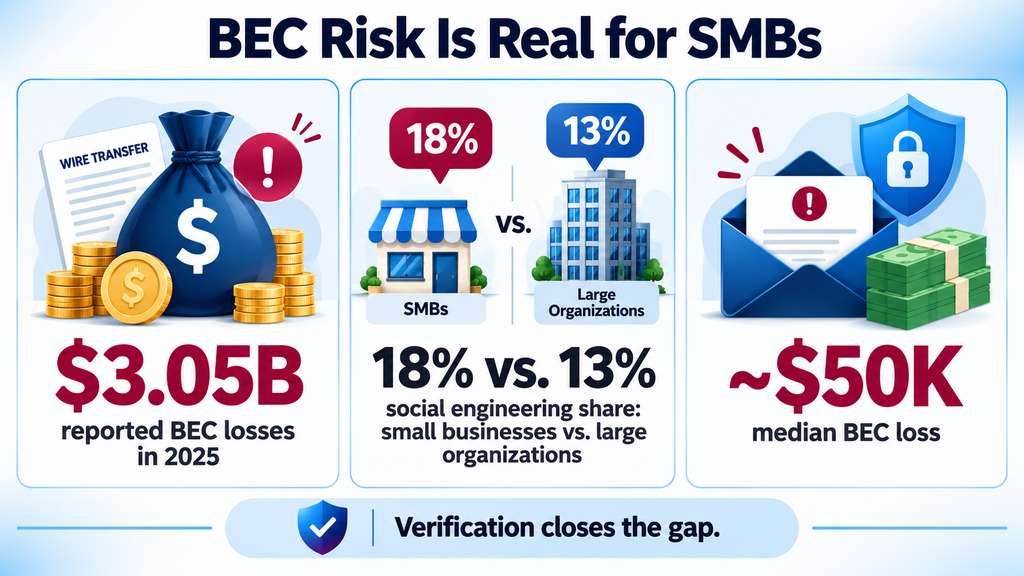
The numbers back this up. According to Verizon’s 2025 Data Breach Investigations Report, social engineering accounts for 18% of breaches at small businesses, compared to 13% at large organizations. Pretexting, the tactic behind most BEC scams, shows up more often at SMBs than at big companies.
The median BEC loss lands around $50,000, real money for a business that size, not a rounding error. None of this is exotic advice either. It’s the same handful of controls that show up on Systems Integrations’ own cybersecurity resolutions for Connecticut businesses every January, because a short set of process changes closes most of the gap here.
Warning Signs of a Business Email Compromise Attempt
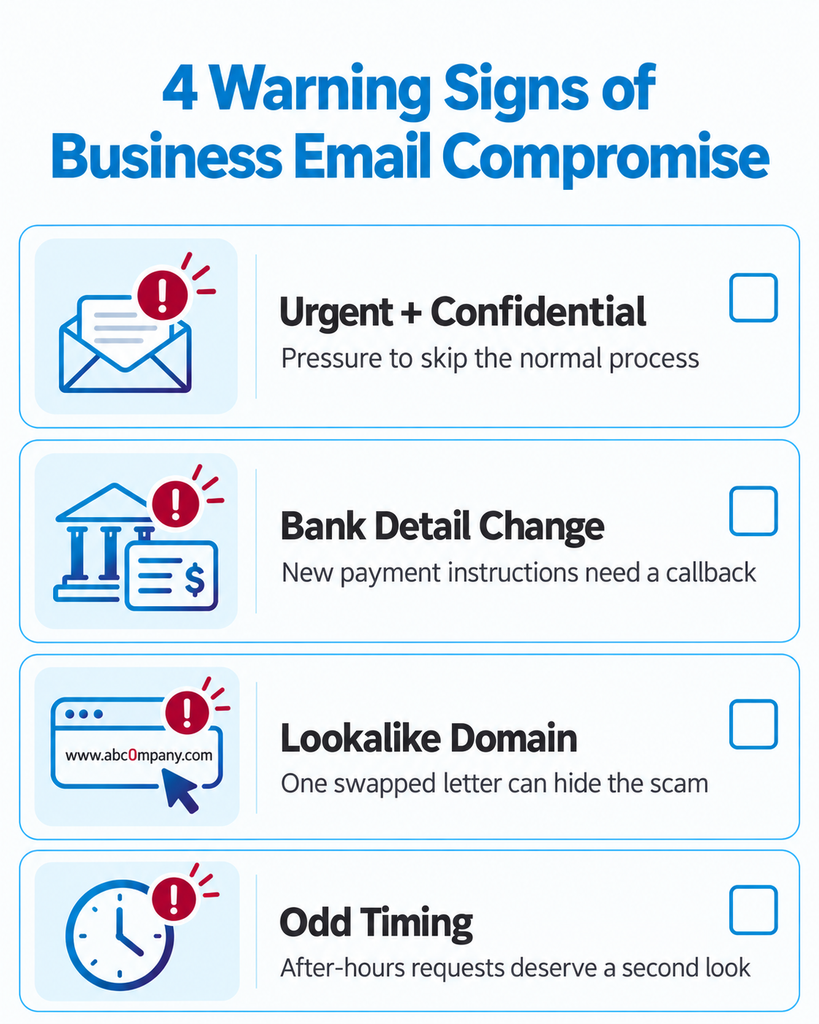
A few details give away most BEC attempts before any money moves.
1. An urgent, confidential request that pressures you to skip your normal process
If an email pushes you to act immediately and quietly, treat that combination as the flag itself. Legitimate requests can usually wait for a phone call.
2. A last-minute change to bank account or payment information
Any invoice or payroll update with new banking details deserves a call to a known number before you touch it, no exceptions, even from a vendor you’ve paid for years.
3. A sender address or domain that looks almost right, but not quite
Check the actual domain, not just the display name. A swapped letter or an added hyphen is easy to miss at a glance, and it’s exactly what the scammer is counting on.
4. A request that arrives outside normal business hours or bypasses the usual approver
A message timed for 6:45pm on a Friday, or one that skips straight to whoever’s covering for the usual approver, is worth a second look regardless of how it reads.
These red flags get more depth in Systems Integrations’ guide on how to get your business cyber ready. It’s worth running through with your team once a quarter.
How to Prevent Business Email Compromise
Prevention here isn’t about one silver-bullet product, it’s a handful of specific, boring controls that work because they close the exact gap BEC exploits.
Multi-factor authentication on every email account is the floor, not the ceiling. It stops most account compromise attempts cold, even when a password gets phished. The FTC recommends pairing that with email authentication, meaning SPF, DKIM, and DMARC records set up correctly, to flag or block a lot of spoofed domains before they ever reach an inbox.
Callback verification matters more than any of it. A phone call to a known number stops more BEC scams than any piece of software. Before changing any payment detail, call the requester at a number you already have on file, never one listed in the email itself.
Pair that with dual approval on wire transfers over a set dollar threshold, so a single convincing email can’t move money without a second person signing off. Staff training closes the loop, and it only works as an ongoing habit, not a slide deck people see once during onboarding. Tie it back to the warning signs above and run it often enough that it sticks.
If your business doesn’t have these controls documented and tested yet, that’s the first gap worth closing. Before you commit to any provider, run through Systems Integrations’ questions to ask before choosing an IT security provider.
What to Do If Your Business Falls Victim to BEC
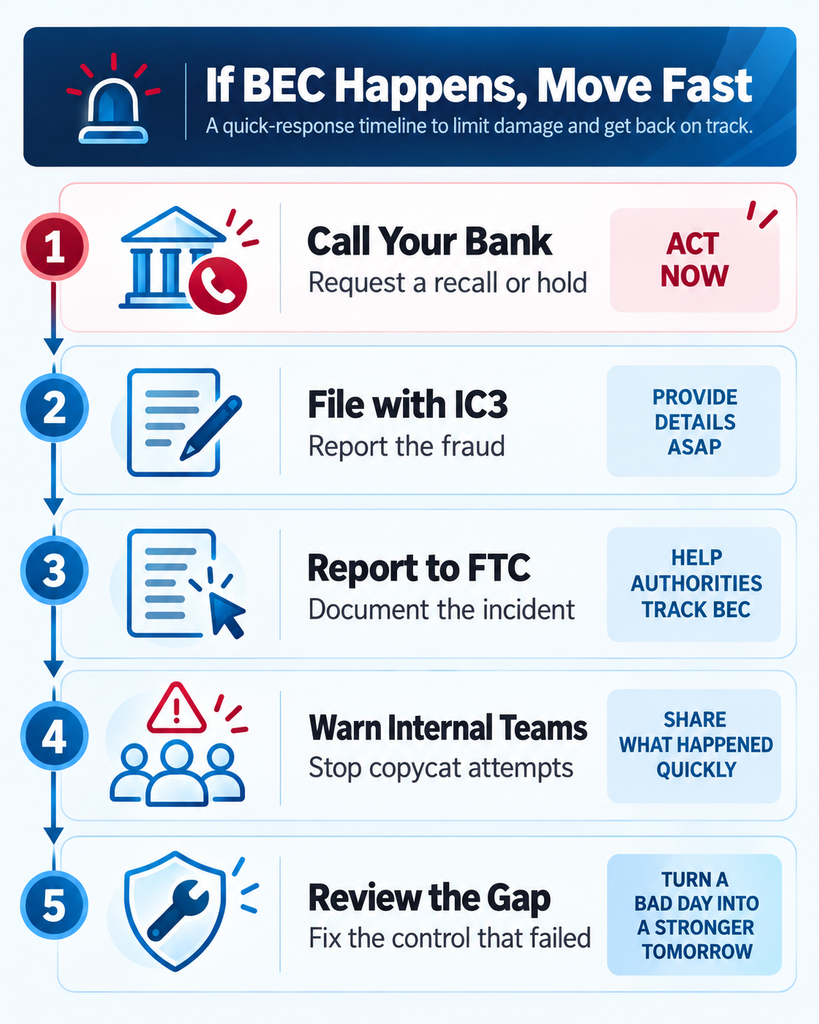
Speed counts for more than anything else once a fraudulent transfer goes out. Call your bank immediately and ask them to attempt a recall or place a hold on the transfer. Banks can sometimes stop or reverse a wire within the first few hours, and that window closes fast.
From there, report it in order: file a complaint at IC3.gov, report the incident at ReportFraud.ftc.gov, and forward the phishing email itself to reportphishing@apwg.org. Acting within the first 24 to 72 hours meaningfully improves the odds of getting money back. In 2025, the FBI’s Recovery Asset Team froze funds in 56% of the cases it worked, a real recovery rate, not a token gesture.
Internally, notify anyone else who might receive a similar request, a vendor, a partner company, another department, before the scammer tries the same move elsewhere. Then review what let the email through in the first place: a missing callback step, a spoofed domain nobody caught, an approval that got rushed. That review is what actually prevents a repeat.
Systems Integrations breaks down how MSPs can help you respond to an attack once one gets through. Having someone on call who already knows your environment cuts the time between discovery and containment. For businesses in a regulated industry, a BEC incident can also trigger reporting obligations. Systems Integrations’ security and compliance support covers that side of it too.
Protect Your Business Before BEC Happens to You
BEC works by targeting trust and urgency, not your firewall. Stopping it comes down to the habits and controls covered above: verification before payment, MFA everywhere, and a team that knows what to watch for.
If your business doesn’t have these controls in place yet, or you’re not sure whether it does, that’s worth a conversation. Systems Integrations builds cyber security services around exactly this kind of risk: right-sized protection, not a sales pitch dressed up as software.
Business Email Compromise FAQs
Phishing usually casts a wide net with a malicious link or attachment. BEC is targeted impersonation with no malware involved, just a convincing request from someone you’d normally trust.
The FBI’s IC3 reported $3.05 billion in BEC losses across nearly 25,000 complaints in 2025, up 10% from the year before.
Sometimes, if it’s caught fast. The FBI’s Recovery Asset Team froze funds in 56% of the cases it worked in 2025, and speed is what makes the difference.
Call the requester at a phone number you already have on file, never one listed in the email itself, before changing any payment detail. That one habit stops most of these scams cold.