
EDR is software that watches your endpoints for trouble. MDR is that same technology with a team behind it, watching, investigating, and responding around the clock. Most small and mid-size businesses in Connecticut and New England eventually need some version of both, and the deciding factor almost never comes down to price. Usually it comes down to whether anyone is reviewing the alerts at 2 a.m. This post walks through what each one does, how they compare, and how to figure out which one fits your business right now.
What Is EDR (Endpoint Detection and Response)?
EDR stands for endpoint detection and response. It’s software installed on laptops, servers, and phones that watches how those devices behave, rather than just checking files against a list of known viruses the way old antivirus tools do. A ransomware process trying to encrypt hundreds of files in a few seconds looks different from normal activity, and EDR is built to notice. So does a login from a device that’s never touched your network before.
When EDR spots something, it can isolate the device, kill the process, or flag it for a person to review. That last part is where it runs into trouble for a lot of small businesses. EDR generates alerts. It doesn’t investigate them. Someone still has to be watching the console at 9am and at 3am, or the alert just sits there until Monday. A growing share of attacks also run code directly in memory using tools already built into Windows, which basic antivirus was never built to catch in the first place.
That’s part of why EDR became the baseline instead of antivirus. It’s also why EDR on its own is rarely the whole answer: catching the behavior is only useful if it feeds into a security stack that someone is actually managing.
What Is MDR (Managed Detection and Response)?
MDR is the same underlying technology, plus a team that watches it. A managed detection and response provider staffs a security operations center around the clock. Someone reviews what your EDR flags, hunts for threats that haven’t tripped an alert yet, and steps in the moment an incident starts.
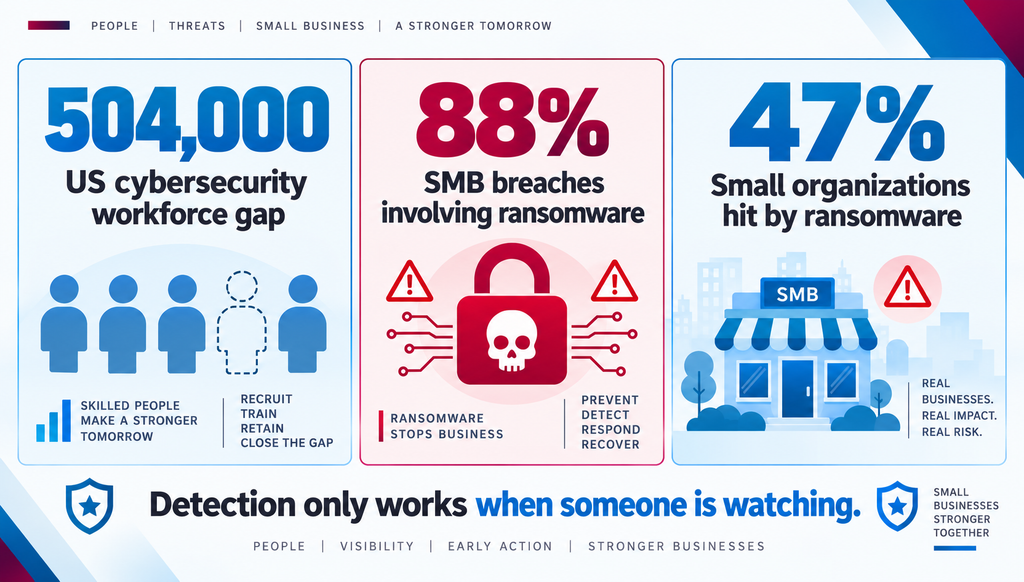
This is less a product decision than a staffing decision. The 2024 ISC2 Cybersecurity Workforce Study put the US cybersecurity workforce gap at roughly 504,000 unfilled positions, with two-thirds of security teams reporting they’re short-staffed. Most SMBs aren’t going to out-hire that market for a single night-shift analyst. That gap is exactly what IT managed services exist to close: you buy the expertise instead of trying to build it from scratch on a small team.
How EDR and MDR Compare
| EDR alone | MDR | |
| Coverage | Individual devices | Devices, plus human oversight of the whole environment |
| Who’s watching | Whoever’s in the office | A staffed SOC, 24/7/365 |
| Response time | However long it takes someone to check the console | Minutes, not days |
| Staffing burden | On you | On the provider |
| Cost model | License plus your own analyst time | Predictable monthly service fee |
| Compliance reporting | DIY | Usually included |
Comparing the license price alone hides the real cost of going it alone with EDR. Self-managed detection also means analyst time, alert fatigue, and whoever’s on call over a holiday weekend. That math changes fast once you factor in what a missed alert costs: IBM’s Cost of a Data Breach Report puts the global average at $4.44 million, and attackers can sit inside a network undetected for months. A zero trust approach limits what an attacker can reach once they’re in. MDR shortens how long they get to sit there first.
5 Signs Your Business Has Outgrown Standalone EDR
You don’t need to be a large enterprise to have outgrown EDR on its own. A few signals tend to show up first.
1. No One Reviews Alerts After Hours
If your team logs off at 5pm and the console doesn’t get checked again until Monday morning, that’s a coverage gap sitting open all weekend.
2. IT Is a Team of One or Two
A single IT person can keep the lights on. Watching a security console around the clock on top of that job is a different job entirely, and it’s not a realistic ask of one person.
3. Your Business Handles Regulated Data
Healthcare records, financial data, and client files all raise the stakes considerably. The 2026 Verizon Data Breach Investigations Report found that 88% of breaches at small and mid-size businesses involved ransomware, a rate far higher than what enterprises see.
4. A Past Incident Took Too Long to Catch
If your business has already had a close call and the honest answer to “how fast did we catch it” is “not fast,” that’s your answer for next time too, unless something changes.
5. Cyber Insurance Now Requires Continuous Monitoring
More carriers are making 24/7 monitoring a condition of coverage, not a nice-to-have. Sophos’s 2025 State of Ransomware report found that 47% of small organizations under $10 million in revenue were hit by ransomware in 2024. Not sophisticated attacks, either. Just unmonitored ones.
How to Choose Between EDR and MDR for Your Business
Your team is the real starting point, before budget even enters the conversation. If nobody can commit to reviewing alerts around the clock, standalone EDR will leave real gaps regardless of how good the software is. Most SMBs under roughly 200 employees without a dedicated security team are better served by MDR from the start. Larger organizations with an internal SOC can layer MDR on top of the EDR they already run instead of treating it as an either-or decision.
Compliance shapes this too. Healthcare practices have HIPAA to think about. Financial and legal firms answer to the FTC Safeguards Rule and, depending on what they handle, PCI DSS. Connecticut businesses holding CT resident data also have the state’s own data privacy and breach notification rules to account for, on top of whatever their industry already requires. The way I’d put it to a client: EDR helps you meet the “reasonable security measures” language most of these frameworks use, but auditors increasingly expect continuous monitoring behind it, which is what MDR provides.
Risk tolerance is the last piece, and it’s the one businesses skip. A week of downtime costs real money, and explaining to a client or a regulator that their data sat exposed for months costs more than that. Price it out honestly, and the monthly cost of MDR starts looking a lot more reasonable.
What EDR and MDR Look Like in Real Business Scenarios
A healthcare or dental practice handling patient records is a frequent phishing and ransomware target, and HIPAA exposure raises the cost of a slow response considerably. Unmonitored EDR might flag the initial compromise. It won’t necessarily stop it from spreading before Monday.
Financial and legal firms carry the same exposure with different regulators attached. And manufacturers running older operational technology alongside their office network often have systems basic EDR wasn’t built to monitor at all, since a lot of that equipment predates modern endpoint tools by a decade or more.
The pattern repeats across every one of these. Software catches the first sign of trouble, and a person still has to decide what happens next.
Get 24/7 Managed Detection and Response for Your Business
EDR is the tool. MDR is the tool plus the team watching it, and for most SMBs, the team is the part that’s missing. If you can’t answer who reviews your security alerts at 2 a.m., that’s the gap to close first, before you spend another dollar on additional software.
Systems Integrations builds 24/7 managed cybersecurity services around exactly that gap, right-sized for your business instead of oversized for a sales pitch. Reach out and we’ll walk through what your current setup covers, and where it doesn’t.
Frequently Asked Questions
No. MDR includes EDR-style technology, but the price difference reflects coverage hours. You’re paying for a team reviewing alerts at 2 a.m., on top of the software itself.
Yes, if someone in-house reviews alerts daily, nights and weekends included. If no one’s watching after hours, standalone EDR leaves the exact gap described above.
Partially. EDR supports the “reasonable security measures” language in most of these frameworks, but auditors increasingly expect continuous monitoring behind it, which points toward security and compliance support rather than software alone.
XDR correlates data across endpoints, email, and network into one platform. MDR is the managed service layer that can run on top of EDR or XDR. This post is about EDR versus MDR specifically, but the term is worth knowing if you see it elsewhere.
It varies by provider and device count, so treat any specific number you see elsewhere with some skepticism. Comparing license fees alone misses most of the bill. Add in analyst salaries, tooling, and after-hours coverage if you’re managing detection yourself, and the gap closes fast.
With MDR, minutes. With unmonitored EDR, however long it takes someone to check the console, which for a lot of SMBs is hours or days rather than minutes.